Field Log
Surfing the Edge: El Salvador's Beauty and Brutal Reality
Half the time I surfed my little heart out, and the other half I lay in bed flattened by heat stroke. My view of the country is still microscopic. And yet, even the short time spent here made my head spin.
Where to begin with El Salvador? Half the time I surfed my little heart out, and the other half I lay in bed flattened by heat stroke. My view of the country is still microscopic. And yet, even the short time spent here made my head spin. We hadn’t been able to visit during our first overland trek through Central America, and in fact, hit every other country on our route. So, this place had become an omission that sat with us. When we returned to Central a year later, we knew it couldn’t be left out again.
But to be in El Salvador at that particular moment threw us into something of a controversial bind. No one in my life, except Adam, was glad we were going. The headlines painted the country as a place of fear and authoritarian grip: a war-torn nation turned experiment in mass incarceration. President Nayib Bukele’s mega-prison, CECOT, loomed large in every international news cycle because of its 40,000 inmates packed behind bars with no chance of leaving.
This was part of a sweeping crackdown that saw 1.5% of the country’s entire population jailed almost overnight. For decades, El Salvador had lived under the shadow of violence, first through civil war, then through gangs that choked communities with extortion and fear. Bukele’s rise promised to break that cycle. But like anything extreme, at what cost?
On the ground, the picture became even more complicated.
Streets that once pulsed with danger now felt safer, but that safety came hand-in-hand with silence, surveillance, and an ominous energy that was hard to name. However, El Salvador’s battles extend beyond politics or gangs, as it’s facing environmental threats like everywhere we’d been on expedition. Think an outrageous surge of plastic clogging the waves that elite surfers ride or rivers suffocating in waste. Not to mention, beaches, quite literally, vanishing grain by grain into the rising tide.
Our surf-centric hotel sat just an hour from the mega prison, yet it might as well have been another world entirely. A longboarding competition was underway, with speakers blasting Latin music inspiring people to dance barefoot while pounding shots. El Salvador was wild in every sense, with harsh contrasts piling on top of even harsher ones.
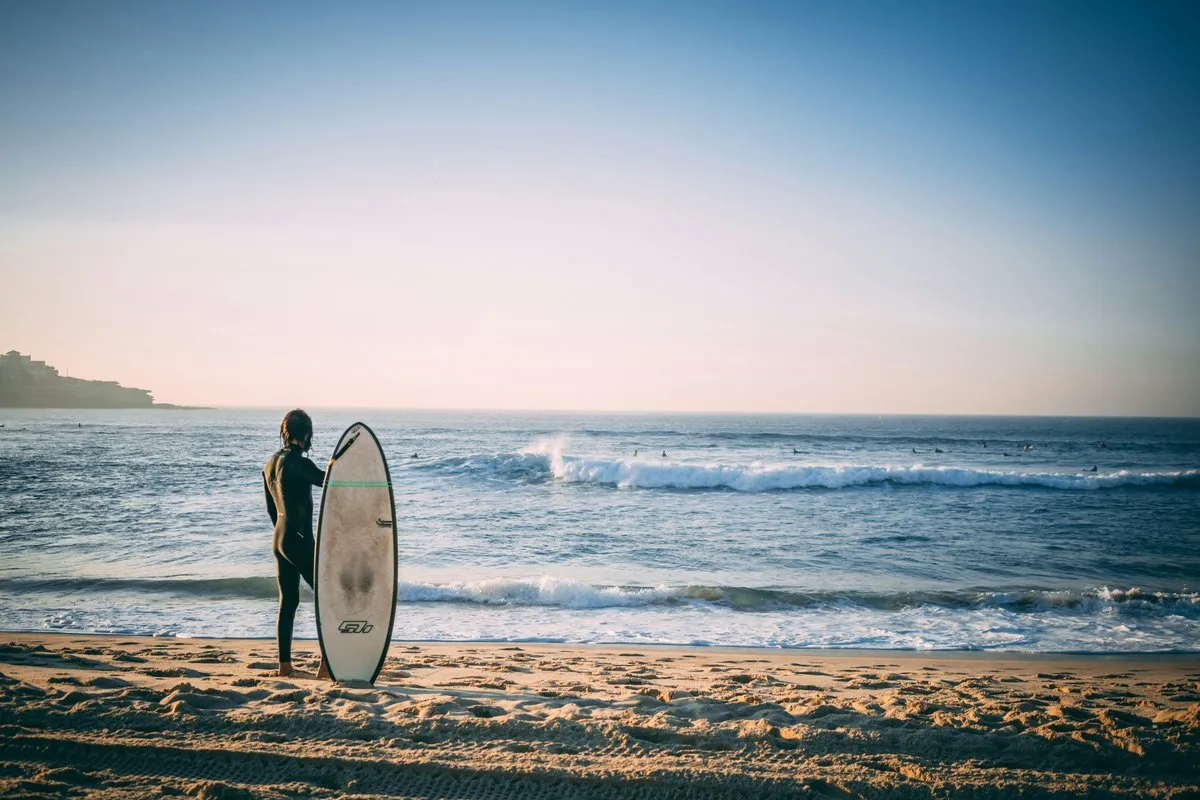
We were posted at a place called Punta Mango, a spot known among surfers but nearly void of women. It was just clusters of American guys on surf trips and the lone Aussie—our very own Adam—holding his own. Then there was me: a beginner, who managed to shock the boys club by showing off my skills, albeit limited ones. Our days fell into a peaceful rhythm of surfing or collapsing into bed. We’d walk up and down the small strip of volcanic black sand when we weren’t surfing or sleeping. From the water, it looked like the paradise we’d been chasing and dreaming of throughout this expediton—home to waves big enough to excite Adam out back, while steady and forgiving for me in front.
But this semblance of paradise cracked the moment we turned back toward shore. The beach was littered with thousands of bottle caps. Not plastic bags or straws. Bottle caps. So many that they seemed to rival the grains of sand themselves. We’d seen this type of “curated litter,” before in different forms. I scanned the catalogue of pollution in my brain to remember the flood of Coca-Cola bottles in Malaysia; the flip-flops stacked knee-high on Christmas Island and; the endless scatter of blue microplastics along Oahu’s North Shore. Here, in Punta Mango, it was caps of every color, washed up like a frat party gone wrong.
We stuffed our hands and pockets with them, knowing full well we were perhaps the first to attempt a cleanup here in awhile.
But this spectacle was far from random. Certain coastlines act like catch basins, shaped by currents, exttreme weather, wind, and geography that funnel floating debris into concentrated zones. Plastic never really disappears. It just breaks down and drifts until the ocean delivers it back to land. What you see on a beach is just a fingerprint of both local consumption and global circulation.
In some regions, discarded flip-flops carried by trade winds, in others, fishing gear or branded bottles traveling thousands of miles. In El Salvador, bottle caps are one of the most common plastic fragments discarded locally. Because they are so light and buoyant, it makes them prime candidates to ride currents until they pile up in staggering numbers. Once here, they don’t go anywhere due to durability. The tide just buries and unearths them, over and over, until the sand itself looks manufactured.
Tthen the coastal erosion came into sight. As tides shifted, waves pushed farther inland, slapping against the deck of our room—something locals told us had never happened before. The coastline was being eaten away beneath us. Coastal erosion is what happens when the natural balance of sand, sediment, and waves is disrupted.
Normally, natural barriers such as dunes, reefs, and mangroves act as great buffers, absorbing the ocean’s energy and rebuilding the shore. But when those defenses are stripped away by human development and encrochment—think deforestation or construction too close to the waterline, or plastic clogging natural drains—the ocean takes what it wants back. You can see it in the jagged tree roots left dangling in mid air where sand once stood. Or in the broken concrete foundations exposed like bone. It shows up in waves climbing higher each season. These sights are hardly subtle once you start noticing them.
By the time the tides shifted and another day passed, we were back out at dawn, 5 or 6 a.m., paddling our hearts out. We celebrated these dirty waters as our surf sanctuary, trying not to swallow mouthfuls of plastic-flecked foam while relishing every single ride. Every wave I caught, I clung to as if it might be my last—stretching it as far as I could, pressing my back heel into the board to milk every ounce of momentum out of those crumbly baby waves I loved so much. Out past me, Adam was carving through the bigger sets like it was second nature. Because for a bonafide Australian, of course, it was.
We felt the need to cherish our sessions out here while we could. There’s no certainty what the future holds for beaches like these.
We spent three days at Mango. Pastel sunsets washed the sky in soft colors, hermit crabs scuttled underfoot. Life felt simple, fleeting, but so good. Then came our time to press forward. We packed up and made our way to the main beach, the stage where the World Surf League hosts a competition each year on the Championship Tour. This was the place we’d come to see up close, the iconic surf haven that lures travelers from around the globe.
The ride there meant three and a half hours of horse and cow crossings, potholes, roadblocks, and people spilling into the streets. And this was just a preview of what awaited. “Surf City” surely lived up to its nickname, as it was home to narrow roads clogged with traffic, neon billboards and crowds everywhere. It was pure chaos and I hated it. I wanted to go back to Mango, back to the ragtag crew of surf bros who’d clap and holler from the beach deck every time I rode a shitty wave.
Maybe it was that jolt—coming straight from six weeks of remote South American Patagonia into this crush of noise and heat—that finally broke me. Or maybe it was the whiplash of moving from cold, dry mountains to pounding equatorial sun. My body gave out. Heat stroke pinned me to bed while Adam went off to chase the waves that had drawn us here in the first place. He’d come back glowing, euphoric from hours in water I couldn’t step into. I, on the other hand, was in store for a time that would sharply contrast Adam’s carefree surf escapades. I traded surf breaks for conversations with the women who worked at the retreat where we were staying.
They spoke of childhoods shaped by violence and decades of gang control that left them terrified to walk their own streets. They talked of robberies and abuse, their lives overshadowed by fear. They spoke of today, and of their president. To them, he was a savior. For the first time in their lives, they felt free. Free to breathe in peace in work and in pleasure. But I knew that to speak against this man is considered treason here. That dissent can end with you vanishing behind the walls of the country’s infamous prison. So was this freedom? Or just power consolidated to a suffocating degree?
The scene unfolding here felt like a reflection or an echo of my own country, where a man in power was similarly building prisons, detention camps, and policies that treated human lives as disposable. To sit in El Salvador, listening to women sing the praises of their leader with such gratitude, I knew there was some sort of looming oddity beneath their approval.
We were staying just thirty minutes from CECOT. That mega-prison sits in a farming town now defined less by crops than by contamination. Rivers run brown and reek of human waste from the incarcerated inside. Locals told us they’re ashamed to call it home, ashamed that their air and water have been turned toxic by the country’s iron-fist solution to crime.
As we headed to the airport, we were being driven by a woman who had tended to me while I was sick. In our chats she told me about the knife attack she survived that took months to emotionally recover from. She was grateful for her own survival, even though she’d always carry the scars. She celebrated the chance to get to know us, as we shared the same sentiment. Her stories of pre and post gang life were interesting, and eye opening. I’ve always found it strange on expedition saying goodbye to someone you simply know you’ll never see again, and that you’ve only known for a moment. Yet it also leaves me uniquely appreciative of these special fleeting moments with kind strangers who are willing to share their stories.
The flight out of strange El Salvador was turbulent as we crossed the Gulf of Mexico—now renamed, absurdly, the “Gulf of America” by our 47th president. Maybe it was just rough air. Maybe it was a metaphor I didn’t want to face: that crossing back home was going to be just as shaky, just as uncertain. It was the worst turbulence we’d felt in two years of traveling, and I couldn’t help but think it held some kind of symbolic resonance.
El Salvador is still a surf paradise, yes. The waves are perfect. But I believe the future will be challenging there, and the present feels like it’s balanced on a knife’s edge. For the first time in a long time, I couldn’t dig myself out of the negative. I just had to sit with it aboard an uncomfortable ride to a place I wasn’t particularly thrilled about returning to. But sometimes sitting with it is all you can do. Exploration isn’t supposed to be all warm and fuzzy. Sometimes, it throws you into the deep end of contradiction: beauty and destruction, joy and fear, freedom and control. El Salvador gave me all of that in a surprisingly short stretch of days, with half of them laying in bed listening to stories of women I’d never see again.
It left me with more questions than answers, but also with a sharper sense of why we press forward. To see the raw truth of these places before they’re forgotten. Before their underwater, both literally and figuratively. To let them change the ways we see the world, regardless of whether or not that change is easy or comfortable.
To be continued …