

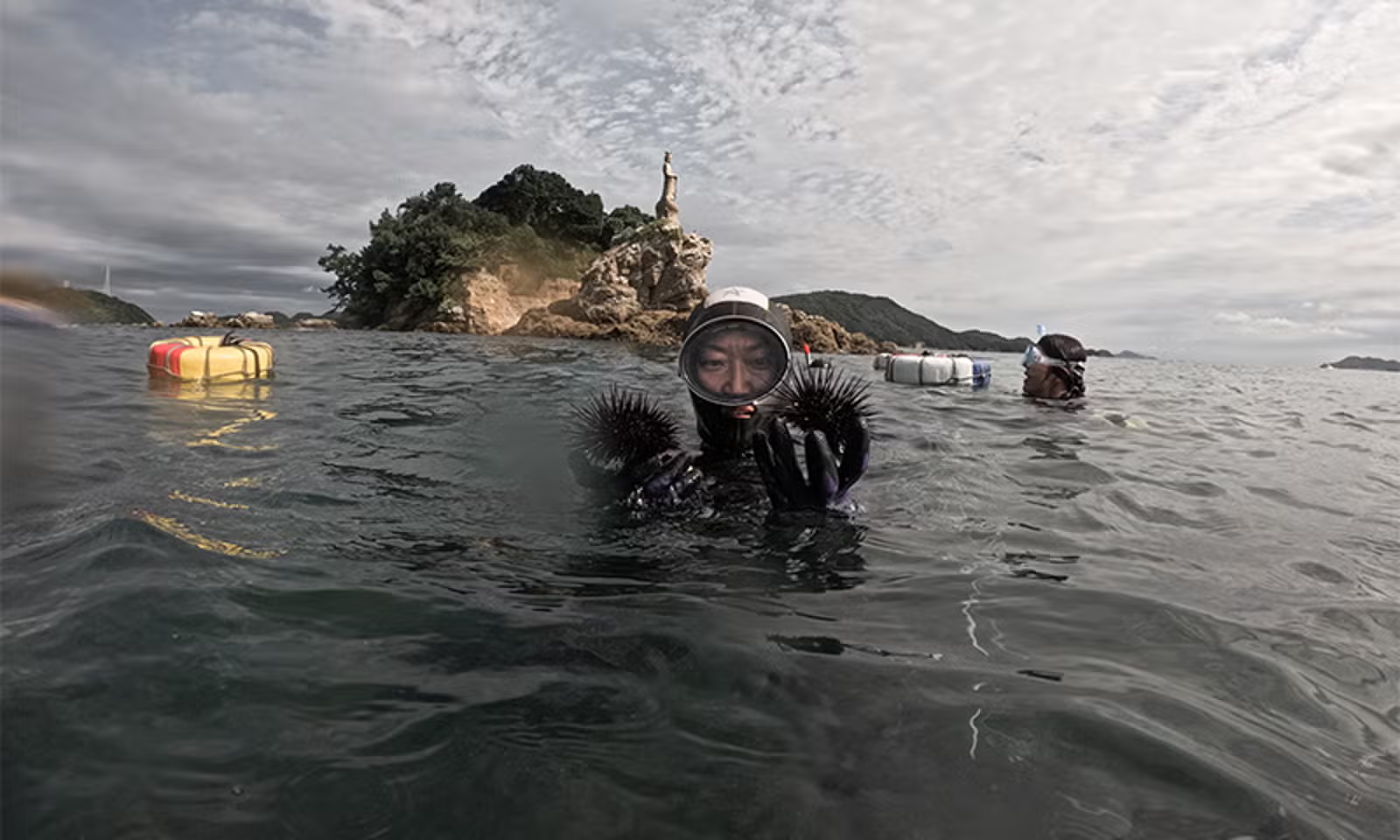
Along the rugged coastlines of Japan's Mie Prefecture, a group of women begin each morning the same way their ancestors did thousands of years ago. They pull on wetsuits, tuck a chisel into their belt, and slip beneath the cold Pacific surface without a tank or a tether — just lungs, focus, and a lifetime of learned instinct. These are the ama divers, and they are disappearing.
In a powerful 2024 report by journalist Sofia Quaglia for Nautilus, the world of Japan's last freediving fisherwomen comes into sharp focus — a portrait of ancient tradition caught between a warming ocean and a modernizing world. The story centres on Ayami Nakata, a 44-year-old mother of five in the village of Osatsu, who has been diving for seven years while also running a grocery store and making jewellery to support her family. On a typical morning, she dives just 20 feet down, takes minute-long plunges, and surfaces with abalone or sea cucumber clutched in numb fingers. "All the stress goes away," she says.
The word ama (海女) translates to "women of the ocean." Archaeological excavations in Toba city have uncovered 3,000-year-old ama tools carved from deer antler. Japan's oldest poetry anthology, the Man'yōshū — compiled around 750 CE — already celebrated their work. For most of that history, the technique barely changed: no scuba gear, no nets, no powered equipment. Divers still use isobue — the "sea whistle" — slowly drawing air into the lungs between dives, their breath rising in calls across the water before each descent.
More than half of Japan's remaining ama divers live in Mie Prefecture, where tightly regulated fishing cooperatives control dive days, catch limits, seasons, and equipment. Abalone can only be harvested during 30–40 days a year. Divers cannot go below 65 feet. One-to-two-hour sessions per morning are the rule. These constraints aren't bureaucratic obstacles — they are the reason this coastline still has anything left to harvest.
The contrast with industrial fishing is stark. Commercial trawlers drag fine-mesh nets across the seafloor, collecting everything indiscriminately. Ama divers pick by hand, one creature at a time, targeting only mature specimens. There is no bycatch. Habitat disturbance is minimal. "By doing it manually, by hand, you only catch what you want to catch," explains Gildas Hardel, a former tourism coordinator now guiding visitors through ama villages.
Yet the three abalone species the ama harvest — Haliotis madaka, H. gigantea, and H. discus discus — are all listed as endangered by the IUCN. Catches that once came easily in shallow water now require 50-foot dives. The culprit is a phenomenon locals call isoyake: the denudation of coastal seaweed and seagrass beds that serve as habitat, spawning ground, and food source for abalone and other marine life. Divers point to warmer currents and rising sea temperatures; researchers also identify invasive sea urchin grazing, chemical runoff, and decades of overharvesting by commercial vessels.
"The catch is less and less," says Kiku Kaito, an ama diver and head of the Kaito Yumin Club ecotourism agency. "The temperature changed, the current changed — we are so angry." Mie Prefecture institutions have been raising kelp, urchin, and juvenile abalone in hatcheries for release into the wild for over a decade, but population recovery takes years the current generation of divers may not have.
Even on a good day, the numbers are difficult. One productive morning harvesting sea cucumbers can yield ¥100,000 (around $800 USD). But across a typical year, a diver earns a few million yen — less than $30,000 — from the sea. Nakata dove only 30 days in the last year. Ama diving, once a primary livelihood, has become a supplementary income at best.
The demographic picture is equally stark. The ama community numbered as many as 10,000 divers in the years after World War II. Today, fewer than 1,200 remain active. The average age is over 60. A 2015 Toba City recruitment campaign attracted just two apprentices from other parts of Japan — and one eventually left. The young women who might have continued the tradition have moved to cities, drawn by more comfortable and reliably paid work.
Tourism has emerged as a partial lifeline. Divers open their amagoya huts to visitors for authentic cooking experiences and cultural demonstrations. The Toba Sea-Folk Museum is pursuing UNESCO Intangible Cultural Heritage recognition for ama diving. Some divers now sell their catch and ama-themed crafts online, reaching customers far beyond their coastal villages.
The ama represent something the Edges of Earth mission holds in high regard: communities that have built a functional, long-term relationship with a difficult environment — not through extraction and abandonment, but through discipline, ecological knowledge, and reciprocity. They harvest only what the ocean can sustainably give. They pass down not just techniques but a way of paying attention to the natural world.
That these women are now threatened not by their own practices but by forces largely outside their control — industrial pollution, climate change, economic displacement — makes their story a microcosm of the broader challenge facing indigenous and traditional ecological communities worldwide. The question the article poses is simple and urgent: can a tradition this old survive an era that has no economic room for it?
Nakata's answer, characteristically, is to keep diving. Two of her children — aged 12 and 14 — have shown tentative interest in learning. She knows it may never be their livelihood. But if they can carry even the spirit of it forward: "Some kind of victory," she says.
Read the full, beautifully reported feature by Sofia Quaglia at Nautilus:
.svg)